What Leave Are Employees Entitled to Under UAE Labour Law?
Under UAE Labour Law, private sector employees are entitled to clearly defined statutory leave, including annual, sick, maternity, parental and special-purpose leave. These entitlements are mandatory, apply to both UAE nationals and expatriates, and set minimum standards that employers must meet or exceed.

The UAE leads the GCC region with its robust framework of employee leave entitlements, provided for under Articles 28 to 32 of the UAE Federal Labour Law (Decree Law No. 33 of 2021) and it’s 2022 Executive Regulations, which govern the labour rights of employees in the private sector.
It applies to all private sector employees working in the UAE, whether UAE nationals or expatriates, but does not apply to employees and workers of the federal government and local government entities; employees of the armed forces, police and security; or domestic workers.
Statutory Leave Entitlements under the UAE Labour Law
How Much Annual Leave Are Full-Time Employees Entitled To?
Under Article 29 of the Labour Law, every employee in the UAE is entitled to an annual leave with full wage, of not less than:
- 30 days for each year of extended service.
- Two days for each month if the service term is more than six months but less than a year.
- A leave for parts of the last year spent at work if the service is ended before using the annual leave balance.
The UAE calculates annual leave based on ‘calendar days’ in employment rather than days spent working, which means that holidays prescribed by law or by agreement are included in the calculation of the annual leave period by default, unless the employment contract or company policies provide more favourable terms for the employee.
However, many employers choose to convert their leave entitlements to ‘working days’ for convenience, which means that weekends and public holidays are not then counted within the annual leave period.
Typically, 30 calendar days corresponds to about 22 working days of annual leave per year for those companies that follow a five-day working week, and 26 working days of annual leave per year for those companies that follow a six-day working week.
With the minimum annual leave entitlement under the UAE Law being 30 calendar days, employers that apply the ‘working day’ annual leave calculation therefore need to provide their employees with a minimum of 22 working days of annual leave per year.
For any employee who has not yet completed one year of service, the Law provides for two days of leave to be accrued per month (or 1.83 days per month if using the ‘working day’ calculation). Accrual begins on the first day of service, but it is at the discretion of the employer to decide whether this provision should be applied to employees during a probationary period.
In practice, this therefore means that employees are entitled to paid annual leave of:
- 30 calendar days (or 22 working days) for each year of extended service.
- Two days for each month (or 1.83 days if using the ‘working day’ calculation) if the service term is more than six months but less than a year.
There is no statutory entitlement to paid annual leave if the service term is less than six months, but many employers permit new employees to take unpaid leave or advance leave. If an employee leaves during a probationary period, they will be entitled to be compensated for accrued days via encashment at the basic salary level.
How Is Annual Leave Calculated for Part-Time Employees and Contractors?
Annual leave entitlement also extends to part-time employees or contractors, but this is on a proportional basis to their work hours. The extending regulations in Cabinet Resolution No.1 of 2022 provides a method to calculate leave accrual for such employees working alternate patterns, as follows.

In practice, if a part-time employee has worked 1,040 hours in the year and the employer provides 30 calendar days annual leave entitlement to full time employees, the calculation would be:
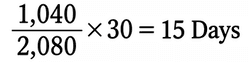
The Law further stipulates that for any part time employee, a minimum of five working days of annual leave must be provided even if, according to the calculation, the proportional amount falls below five working days.
Independent contractors, or freelance workers, who are neither on an employment contract with the employer nor are linked by a Work Permit or Visa, would fall outside the scope of the UAE Labour Law. Their leave rights would be dictated by whatever has been mutually agreed upon in their Service Agreement.
Who Controls Leave Scheduling and Carry-Over Rules?
All employers in the UAE should have conditions around scheduling leaves and carry-overs outlined and clearly defined in their company policies.
The UAE Labour Law provides that an employer may set the dates of leave according to work requirements, in agreement with the employee, or may grant leave in rotation among employees to ensure business continuity. Employers must notify the employee of the leave dates at least one month in advance.
Employees should utilise their entire leave entitlement in the year it is due. However, with the consent of the employer and in accordance with company’s regulations, they may carry over unused annual leaves (or part thereof) to the following year. In this case, If the employee chooses to receive an encashment for the unused days, they will be entitled to payment calculated on the basis of basic salary.
Employers have the right to refuse leave requests based on scheduling complications but may not prevent an employee from using their accrued annual leave for more than two consecutive years.
What Are an Employee’s Sick Leave Rights in the UAE?
The UAE Labour Law sets out a comprehensive framework for sick leave under Article 31. All employees in the UAE are entitled to up to 90 days, continuous or intermittent, of sick leave per year, on the following basis:
- First 15 days – full pay.
- Next 30 days – half pay.
- Remainder – unpaid.
An employee that is unable to work, due to a condition not arising from work injury, must inform the employer or representative about the sickness within a period not exceeding three working days and submit a medical report (sick leave certificate) from a healthcare professional.
In practice, most employers in the UAE only request a certificate for any sickness related absence that exceeds three days. Obtaining a sick leave certificate from a healthcare professional is, in most cases, is a chargeable service that the employee must bear.
The UAE Labour Law clarifies that entitlement to paid sick leave is only granted for illness or injury that does not arise from the misconduct of the employee, in accordance with the Regulations.
Employees in the UAE are not entitled to paid sick leave during the probationary period. However, the employer may grant a sick leave without pay, based on a medical report from a healthcare professional. Many employers elect to grant paid sick leave entitlement from day one of employment.
Under the UAE Labour Law, employers cannot terminate an employee either during their sickness, or due to their sickness, within the 90-day entitlement period. However, an employer can consider termination on medical grounds at the end of the 90-day entitlement period but must ensure that all financial entitlements are paid in line with the Labour Law and Regulations.
Employers should only agree to an employee returning to work if they provide an updated medical report stating the employee is now fit to work. For absences that are longer than seven days, or absences due to serious illnesses, employers can also consider phased returns before the employee resumes their normal hours.
As a best practice, companies should also conduct return to work (RTW) interviews with employees on their return to the office. RTW interviews are informal, supportive meetings between an employer and employee for ensuring the employee is fit to return, addressing any underlying health issues, updating them on workplace changes, and arranging necessary support or adjustments.
What Maternity Leave Entitlements Apply Under UAE Law?
Female employees in the UAE are entitled to paid maternity leave under Article 30 of the UAE Labour Law. This entitlement is not tied to a minimum service period and is available to all female employees from day one of employment.
The maternity leave entitlement is currently 60 calendar days in total, of which the first 45 days is fully paid and the remaining 15 days at half pay. It must be granted upon the employee’s request, at any time starting from the last day of the month preceding the month in which she is expected to give birth.
Employees may also, after using the maternity leave, be absent from work without a wage for a period of up to 45 days (continuous or intermittent) if it is due to sickness or the child’s sickness resulting from pregnancy or childbirth, which does not allow her to return to work.
In such cases, a medical report from a healthcare professional is required and the period of absence will not be included within the service term for which the female employee is entitled to end of service benefits or the period of contribution in the retirement scheme.
The Law also extends the statutory maternity period for a further 30 days of fully paid leave and a subsequent 30 days of unpaid leave if the baby is born sick or with a disability that requires constant care. A medical report is again required to support this extended leave.
The statutory maternity leave entitlement applies to female employees in the UAE in cases where a miscarriage or still birth occurs after six months of a pregnancy, or to female employees who adopt an infant that is under six-months old.
Female employees are also entitled to utilise their annual leave entitlement in conjunction with their statutory maternity leave period and to utilise their statutory sick leave entitlement (15 days full-paid and 30 days half-paid) before they utilise the additional 45 days of unpaid leave in instances where the employee falls ill or suffers a medical complication due to the pregnancy.
It is not permissible to terminate the service of a female employee (or notify of termination) due to pregnancy, taking maternity leave or being absent from work in accordance with the provisions of the Law.
After returning from maternity leave and for a period of not more than six months from the date of delivery, the female employee will be entitled to one or two breaks per day to breastfeed her child, provided that the two nursing breaks do not exceed an hour.
How Does Shared Parental Leave Work in the UAE?
The UAE Labour Law further provides for a paid parental leave period of five working days, continuous or intermittent, to allow both parents to take care of a newly born child. It is available to both the father and the mother during the six months after the date of the child’s birth.
The Law provides no length of service condition for an employee to be granted this leave, so it is available from day one of employment. In the case of female employees, the parental leave entitlement is in addition to the maternity leave entitlement.
Whilst this is a statutory entitlement, many employers offer flexibility around the birth of a child to their male employees and may, at their discretion, grant more than five days.
When Is Bereavement (Compassionate) Leave Granted?
The UAE Labour Law provides paid bereavement leave (also known as ‘compassionate leave’) to enable employees can take time off to mourn and manage family affairs in the event of a death in the family. All employees are entitled to:
- Five days paid leave on the death of a spouse.
- Three days paid leave on the death of an immediate family member ¬– parents, children, siblings, grandparents or grandchildren.
The bereavement leave period starts from the date of death and must be taken immediately. The employee is paid full salary, and the leave period does not affect their annual leave entitlement.
Any additional leave required must be taken from annual leave or as unpaid leave unless the employer grants an exception at their discretion. Some employers may require proof (like a death certificate) for their records.
Who Qualifies for Statutory Study Leave?
To encourage continuous learning and development, the UAE Labour Law provides study leave for employees who are furthering their education. An employee is entitled to 10 working days per year of paid study or exam leave provided they have at least two years of service with the employer and are enrolled in an approved educational institution in the UAE.
What Is Sabbatical Leave for National Service?
The UAE Labour Law provides a special sabbatical leave entitlement for all Emirati nationals employed in the private sector who are called up for National Service (typically, military service). This is to ensure that Emirati employees do not lose employment or salary while serving their country.
The sabbatical leave entitlement, which typically lasts for 12 months or more depending on National Service requirements, is for fully paid leave and the employer must hold their job open for them until they return.
How Is Leave Pay Calculated and Encashment Handled?
Leave salary during the period of employment is generally calculated at the gross salary level (basic salary plus all additional components). This also applies to other types of leaves such as maternity leave and sick leave, where there are full-pay or half-pay stipulations.
Calculating leave salary will depend on whether a UAE employer has adopted the ‘calendar days’ or the ‘working days’ formula.
For a ‘calendar days’ employer, the calculation is:
- (Monthly Gross Salary x 30 x 12) ÷ 365 = Daily Salary Rate
- Monthly Gross Salary ÷ 30 = Daily Salary Rate
For a ‘calendar days’ employer, the calculation is:
- (Monthly Gross Salary x 12) ÷ 260 = Daily Salary Rate
- Monthly Gross Salary ÷ 22 = Daily Salary Rate
However, leave salary for encashment purposes – for unused days of a statutory entitlement or when an employee is being off-boarded – are always calculated at basic salary level only. Some employers choose to extend the gross salary calculation for off-boarding employees as an enhanced benefit.
What Leave Benefits Go Beyond UAE Statutory Minimums?
Beyond the mandatory leaves outlined above, many employers in the UAE offer additional leave benefits to their employees as part of their talent recruitment and retention strategies. These leaves are not required under UAE Federal regulations, but are governed by internal company policies and procedures, and are mostly offered as an additional supplement to the statutory leaves.
Examples of non-statutory enhanced leaves would include:
- Birthday Leave – some UAE employers have adopted the discretionary practice of offering a day of leave on or around an employee’s birthday.
- Religious/Cultural Leave – as the UAE’s official public holidays only cover Islamic holidays, some 25% of UAE employers have adopted the discretionary practice of offering a day or two of leave for employees to observe their own important religious or cultural holidays, such as Christmas or Diwali. Such leave periods cannot be provided as a replacement to statutory public holidays. Any employee who works during a statutory public holiday must be compensated with overtime payments or time off in lieu (TOIL).
- Marriage Leave – the UAE government has introduced marriage leave entitlement in the public sector, but it remains as a non-statutory leave in the private sector. A typical discretionary practice would be to grant three to five days of paid leave to employees who are getting married.
- Dependent Care Leave – a few UAE employers have adopted the discretionary practice of offering leave to employees specifically to care for a sick family member where there is a lack of other care available. This might involve a number of paid or half-paid days per year, or simply the flexibility to work from home.
- Voluntary Leave – many UAE employers now offer employees one or two days paid leave per year to volunteer for charitable causes or purposes as part of their Corporate Social Responsibility (CSR) commitments.
- Wellness Days – as employee welfare continues to grow in importance in the UAE, some 20% of UAE employers have adopted the discretionary practice of offering wellness leave days or mental health breaks for employees. Typically, employers offer employees a few days of paid leave per year to recharge without using up their annual leave.
- Enhanced Maternity/Paternity Leave – some UAE employers have adopted the discretionary practice of introducing more European-style parental leave entitlements. This can be in the form of extending maternity leave to a period of up to six months or extending paternity leave by an additional month.
- Enhanced Annual Leave – many UAE employers have adopted the discretionary practice of offering employees enhanced annual paid leave entitlements that are beyond the UAE statutory entitlement of 30 calendar days (or 22 working days).
- Unpaid Leave – employees may, at the discretion of the employer, request to take unpaid leave for personal reasons if their statutory entitlement is exhausted. Under the UAE Labour Law, an unpaid period of absence is not included within the service term for which the employee is entitled to end of service benefits or the period of contribution in the retirement scheme.